Thursday, July 26, 2018
United We Win Hard Left On Class Struggle Challenging Consensus And Fighting The Most Important Fight
United We Win Hard Left On Class Struggle Challenging Consensus And Fighting The Most Important Fight
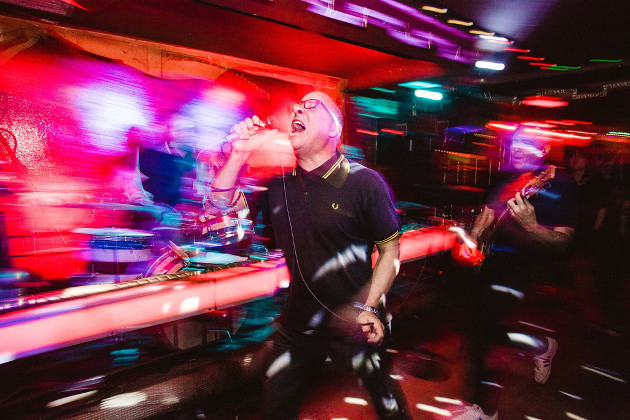
[PHOTO: Gina Clyne Photography] Oakland hard mod quartet Hard Left have surely released one of the best punk records of the year, and its neatest feat is being Really Fun and Actually Meaningful at one and the same time. The combo is comprised of veteran musicians whose collective credits include work with the legendary acts Black Tambourine, Boyracer and Lunchbox. Its cracking full-length debut We Are Hard Left came out earlier this week on Hard Lefts own Future Perfect imprint, and it is propelled by big guitars and bigger guitar hooks, growled exhortations and ganged choruses. Even before we got our hands on the record back in March, we were struck by the entirely refreshing way Hard Left foregrounded its politics in early singles; if anything, the full-length doubles down on doling out messages of unity and informed dissent in vibrant, fist-pounding anthems like "Kicking It Off" and "Hard Left Rules OK," to name but two. As we found out, that is no accident. After chewing over the place of big-picture politics in contemporary indie rock in a chat window with fronter and co-founder Comrade Mike, we decided to throw open our conversation into a more in-depth interview. Comrade Tim, guitarist and singer for Hard Left, joined in on the fun, and the results are below. As much as we are grateful to Mike and Tim for the time they gave to this discussion, we are even more grateful for the forthright political message in their music. We think the guys would agree that the world doesnt need just another punk record; we would submit that what it needs is THIS punk record -- and more like it. Recent album release shows for We Are Hard Left have been described as "total chaos," and it is heartening that the audience is out there, ready for this music and its message. But, as we all know from consuming "news" "reports" every day, there is a lot more work to be done. Hard Left gave its record away one song a week ahead of its release, but if you have not yet heard it (and even if you have), jump to the bottom of the piece, click play on the Bandcamp embed, and then hop back up here and dig in.
Clicky Clicky: There is something very optimistic about We Are Hard Left -- its right there in the opening lyrics of the record, innit? Just the fact that the record exists is a reassurance that there are plenty of reasons to be hopeful. Was that something the band felt was important to express?We Are Hard Left is available now as a 45RPM LP or digital download via the acts Bandcamp page right here. The LP comes packaged with a lyric insert and sticker, and its vivid cover art is our favorite of the year so far. A special bundle includes an iron-on patch bearing the slogan "All Power To The Imagination." Hard Left is contemplating a run of East Coast dates for mid-August, so keep an eye out for possible news on that front. Hard Left rules, OK? OK.
Tim: Definitely. We are into the concept of uplift, and try to inspire a sense of common purpose and utopian possibility.
Mike: Absolutely correct. Given the challenges we all face right now its so easy to be negative, preachy and finger-pointy. We want to avoid that vibe at all cost.
CC: There is a lightness to the record that comes from the tempos, the energy, the big guitars. It sounds like it was a lot of fun to make. I think all of you have known each other for some time. When you decided there was going to be this thing called Hard Left, was the idea of the band espousing a political message something that was right there from the beginning? Or were you guys excited just to have the opportunity to play together?
Tim: Well, Mike and I always tell the story of how we hatched this idea. We were hanging out at SLR headquarters, and I randomly said "Im thinking about trying to join an Oi band," and Mike looked right at me and said "Lets form an Oi band!" A couple of weeks later, we were at the Rain Parade show in San Francisco, and I said, "you know, if were going to do this band, it needs to be explicitly left;" and Mike said "yeah, HARD Left." And there it was. So the political message was central, always, but it kind of came about with the musical idea simultaneously. But in terms of lightness, yeah, I think we have a similar vision of a band that is serious in its politics, but doesnt take itself too seriously, and is vibrant in aesthetic terms, and is fun. We do get into a bit of pageantry and self-stylization, and we think that that adds to, rather than detracts from, the political message.
Mike: And youre right, the record was a lot of fun to make, and kind of easy as well. Donna, Tim and I worked on the songs a bit at home, went to AZ and ran through them a few times with Stew, then we hit record. All of the arrangement ideas and the excitement seem to come very naturally. So it is crazy fun.
CC: Something the blog has harped on at irregular intervals over the years has been the lack of political engagement by bands in the late 20th and early 21st century. The last song that got me really excited about the power of dissent and the potential for change was Report Suspicious Activitys "Subtle," and looking at the archives now I see that was 10 years ago. Vic Bondi is of a certain age, and I dont think there is a person involved in this interview whose age doesnt start with a 4. Recognizing that none of us is a sociologist, why do you think younger musicians arent driven to tackle the important, macro issues now? The reaction to the Reagan/Thatcher era felt so electrifying, so strong, even from the safe suburban enclave in which I was raised. The reaction to the Bush era... well, at this point I cant even tell if there was one.
Tim: I dont know. This is a really good and important question. I think the spirit of resistance comes in waves; and, a few important examples aside, we seem to be in the trough right now. I think its seen not to be "cool" now to engage with anything, unless its the minutia of personal taste-based stuff, like making artisan pickles or whatever. Not to single people out. I mean, food consumption and production is actually a really important site of struggle now, and will be even more so in the future. But I do think theres a suspicion of systematic analysis, married with a feeling -- carefully inculcated by the mainstream media and "liberal" opinion -- that things "went too far" in the 1960s, and that to be a "reasonable person" is to more or less accept the neo-liberal consensus, and eke out whatever personal resistance you can in matters of taste and consumption. Systematic analysis is brewing, and it will come back big time. History is never over.
Mike: I do think that there is a lot of engagement in issues of personal and identity politics right now, and thats great. There is a lot of talk about with those issues too, but we want to push people a bit to look at the bigger picture too.
CC: I wonder if it is not something to do with the fact that today there arent as many chronologically proximal role models, meaning musicians championing progressive politics or dissenting politics, for bands today as there were for bands in the 80s. Even Hard Left looks to the 70s for inspiration, not just musically, but also politically, yeah?
Tim: Hard Left looks back as far back as 1789, but we also look to stuff in the present.
Mike: That might have something to do with it. But I do think that theres also a sense of hopelessness right now, the idea that whats wrong is just too big and too entrenched that theres no point in fighting back. As Tim states, any "reasonable person" accepts the neo-liberal consensus, when in fact it is that very ideological orthodoxy thats led us to this very dangerous point in history, politically, economically and ecologically.
CC: Say what you will about baby boomers and boomer nostalgia, but at least the legacy of 60s social protest echoed in some of the music of the 80s. But that echo didnt in turn echo with bands in the oughts. Was there anything happening in music a decade ago that relates to the progressive ideals that Hard Left is trying to promote?
Tim: Hmmm, dunno. I am tempted to say that there is no authentic youth culture any more, in the sense that youth subcultures used to at least nominally have some kind of political resistance attached to them. I think the commodification of everything has pretty much won. The very idea of the "hipster" illustrates this. The original "hipster" of the 1950s and 60s was someone who enacted a deep break with bourgeois culture, possibly in a political sense, but certainly in a more broadly cultural and spiritual sense (the Beats and so on). Its hard to see anything in modern so-called hipster culture that is dangerous, subversive, anti-conformist, or in any way breaks with the reign of commodification as first principle of bourgeois society. The problem with boomers and nostalgia for the 1960s is that it leaves out what was really going on in the 1960s. Pretty much the annoying part is all that is remembered -- tie dye or whatever. The multi-generational cross-class anti-authoritarian uprising against state violence (in Vietnam and at home) etc. etc. etc. is largely forgotten. Whose interests does that forgetting serve? The past always comes back as caricature. Im old enough to remember, for example, that when punk started, it wasnt about mohawks. No one had a fucking mohawk or whatever. It was freaks plus "normal" people. And it was similar to the earlier revolt of the Beat generation. Smart, ironic, NOT buying in. No more heroes.
Mike: Just in terms of making and disseminating music, I might have expected the technological revolution of the late 90s/early 00s (home recording, cheap production, almost-free online distribution) might have had a more progressive resonance on the ideas behind the music as well. But it seems like a lot of the energy behind Internet-enabled arts production seems to head in a libertarian direction rather than one that seeks collective solutions to common problems.
CC: The real travesty is there is now little disagreement among the arts class, the music class, the creator class, whatever you want to call it, that the political system is broken, and that issues like income inequality and climate change must be addressed. One thing we talked about briefly a few weeks ago is that there is a willingness in indie and punk rock to pursue and promote identity politics or personal politics, but not to engage with macro political issues. Looking back, can you pinpoint where this turn away from macro issues toward identify politics could have happened?
Tim: Ill probably catch flack for it, but I think in an era of massive exploitation and take-backs, destruction of the planet, and unending war, there are bigger problems than whether your feelings are hurt because society doesnt recognize your particular flavor. Its too easy. It doesnt challenge capital at all. At THIS moment, I think class struggle needs to be in the foreground. What do I mean by class struggle? Let me be clear that I do NOT mean a too-easy demonization by each of the person just above them on the socioeconomic ladder. And I do not mean some kind of Old Left focus on "the workers" in the sense of factory workers. I DO mean a focus on who is doing the work and who is taking the profit produced by that work. Hard Left stands for a society in which the people who DO the work make the decisions about how the work is to be done, and reap the benefits of the work. Hard Left is about the "we" instead of the "I". A society in which each feels he or she is in a personal war with others for scarce resources is a not a society worth living in. I would add, however, that issues of race, gender, sexual orientation, etc., HAVE to go together with the class struggle. There cant be any separation between them, because they arent separate in reality.
Mike: Im reminded of a bit in the DC installment of the Foo Fighters "Sonic Highways" show, where Rick Rubin talks about US kids not being able to relate to punk because it was too much about class politics, and when US HC started talking about personal politics that it then became something that American kids could relate to. And I think that you can see that shift in emphasis throughout the 80s and 90s. As Tim points out, identity issues do go hand-in-hand and interact with class issues, but I guess one might say that its easy to get caught up in the trees and lose sight of the forest.
CC: Ive got my own theory, and it is spelled g-r-u-n-g-e. I love everything Kurt Cobain did, but I feel like he is standing at a fork in the road. My favorite Youth Of Today song is "Disengage," but thinking about it in this context -- and knowing what we know about where Ray Cappos head was at at the time -- I almost wish he was more specific: disengage with popular culture, disengage with consumer culture, but please, please, please fight like hell out in the streets against injustice. But instead, the message 20 to 25 years ago wasnt even the 60s "turn on, tune in, drop out" -- it was just "drop out." Whether or not you agree that underground rock and roll got us into this, can underground rock and roll get us out?
Tim: Probably not. But we do what we can.
Mike: I hope so!
CC: Comrade Mike, purely from a practical perspective, it seems like singing these songs must be pretty physically demanding, at least on your throat?
Mike: It is, but I suppose Im getting more and more used to it and it bothers me a bit less. Whats kind of odd is that I wasnt really sure what was going to come out when I opened up my mouth to yell. That gravelly yell wasnt intentional, it just sort of happened and has now become part of the our style.
CC: Youve been giving away one song a week from the new record, and will have given away the whole thing by the time of the official release. Hard Lefts music is definitely for the proletariat, and it feels right to make it directly available to the people. But, of course, thats no way to sell a bunch of records. Or is it? Was the decision to give the music away a reflection of the bands politics, or an acknowledgement of the problems the music industry has found itself in since the turn of the century?
Mike: Both, really. We dont look at that band as any sort of money-earner, and really the goal is to get people to listen to the music. If they want to and can afford to buy an LP, thats great too, and we made the LP to be as high-quality and as affordable as possible so that people who do buy it get something nice for their money. I dont have any problem with people being compensated for their artistic work and so I dont have the opinion that all music should be free, or that downloads are necessarily inherently worthless, it just felt right to us. Giving away the download removes a lot of friction from getting the music out there, and once we decided to do that, then I just wanted to think of a way to get the most value out of it for the band. The song-a-week thing seemed like a nice way to get people excited about the record and loop-in as many blogs and music sites as possible, in hopes of spreading the music as widely as possible.


Hard Left: Bandcamp | Facebook | Soundcloud
